Flange Manufacturing, Forging, Machining & Quality Control for Alloys
Industrial flanges play a vital role in ensuring safe and leak-free piping systems across industries. Whether used in petrochemical plants, marine applications, power generation, or fabrication projects, their reliability depends on how they are manufactured. Understanding the monel flange manufacturing process helps engineers, procurement professionals, and project managers evaluate product quality beyond material selection alone.
From selecting premium raw materials to forging, machining, inspection, and final certification, every stage contributes to the flange’s performance. Furthermore, a well-controlled manufacturing process improves durability, corrosion resistance, dimensional accuracy, and operational safety.
This guide explains the complete production journey of stainless steel, Monel, Inconel, and nickel alloy flanges while highlighting the inspection standards that ensure consistent industrial quality.
The Importance of Quality in Flange Manufacturing
Industrial flanges often operate under extreme temperatures, high pressure, and corrosive environments. Consequently, even minor manufacturing defects can affect the integrity of an entire piping system.
A carefully managed production process offers several advantages:
- Better dimensional accuracy
- Improved mechanical strength
- Enhanced corrosion resistance
- Reliable sealing performance
- Longer service life
- Reduced maintenance requirements
For this reason, manufacturers follow structured production methods and quality standards throughout the manufacturing cycle.
Understanding the Monel Flange Manufacturing Process
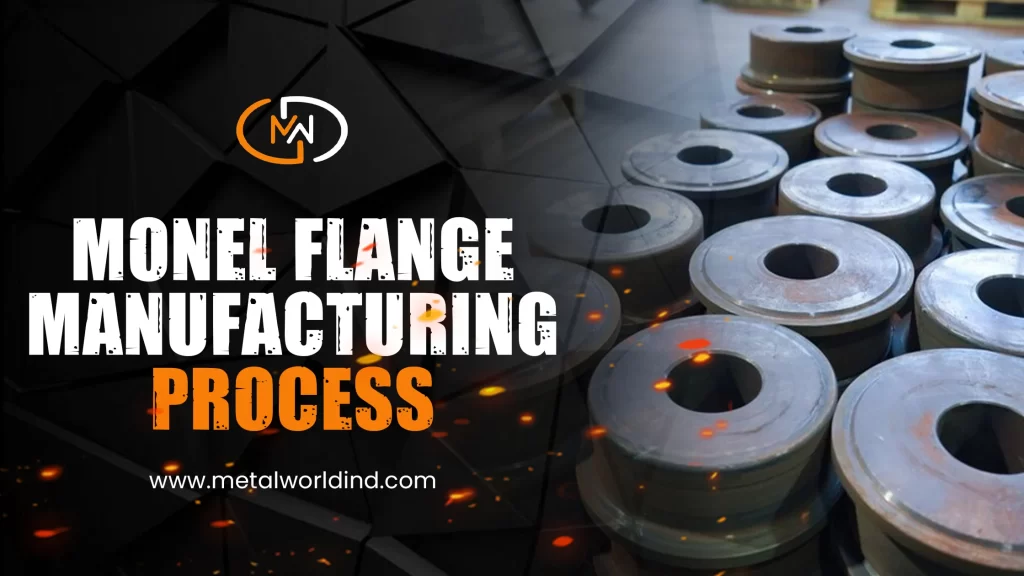
Monel Flange Manufacturing Process: Step-by-Step Overview
The Monel flange manufacturing process begins with selecting certified Monel alloy material that meets industry specifications. Since Monel contains high levels of nickel and copper, it provides outstanding resistance against seawater, acids, and chloride-rich environments.
Once the raw material is approved, it moves through forging, machining, heat treatment where required, inspection, and finishing before final dispatch.
Every production stage is closely monitored to maintain consistent product quality.
Step 1: Raw Material Selection
Every reliable flange starts with premium-quality metal.
Manufacturers source stainless steel, Monel, Inconel, and nickel alloys from approved suppliers with complete material traceability.
Before production begins, the nickel alloy raw material quality inspection verifies:
- Chemical composition
- Material grade
- Surface condition
- Mechanical properties
- Heat numbers
- Traceability records
This early verification reduces production risks and ensures compliance with project specifications.
Step 2: Forging the Flange
Forging transforms raw metal into a dense and durable flange blank.
During this process, heated metal is shaped under controlled pressure using forging equipment. This improves grain flow while enhancing mechanical strength compared to cast components.
The forging stage helps eliminate internal voids and increases resistance to fatigue, pressure, and impact loading.
As a result, forged flanges are preferred for demanding industrial environments.
Step 3: Heat Treatment for High-Performance Alloys
Some nickel-based materials require carefully controlled thermal processing after forging.
The inconel flange forging and heat treatment process improves mechanical properties while relieving internal stresses created during manufacturing.
Depending on the alloy grade, manufacturers may perform:
- Solution annealing
- Stress relieving
- Controlled cooling
- Aging treatments
Proper heat treatment helps maintain corrosion resistance and long-term structural stability.
Step 4: Precision Machining
Once forging is complete, the flange enters the machining stage.
Modern CNC equipment produces highly accurate dimensions that ensure proper installation and sealing performance.
Common stainless steel flange machining methods include:
- Turning
- Facing
- Drilling
- Boring
- Thread cutting
- Grooving
Precision machining ensures compatibility with pipes, valves, and other piping components while maintaining tight dimensional tolerances.
Step 5: Surface Finishing
Surface finishing prepares the flange for its intended application.
Depending on project requirements, manufacturers may apply:
- Smooth machine finish
- Raised face finishing
- Ring-type joint preparation
- Protective cleaning
- Surface polishing
A properly finished sealing surface helps improve gasket performance while minimizing leakage risks.
Quality Control Throughout Manufacturing
Inspection is not limited to the final production stage.
Instead, comprehensive flange manufacturing quality control procedures are followed from raw material receipt through finished product inspection.
These checkpoints help identify issues before they affect the final product.
Manufacturers typically maintain documented inspection records for complete traceability throughout production.
Positive Material Identification (PMI)
Material verification is especially important when producing high-value nickel alloys.
PMI testing for monel and inconel flanges confirms that each finished component contains the correct alloy composition.
Using specialized analyzers, inspectors verify:
- Nickel content
- Chromium levels
- Copper percentage
- Alloy consistency
PMI helps prevent material mix-ups that could otherwise lead to costly failures in critical industrial systems.
Dimensional Inspection
Every finished flange undergoes detailed dimensional verification.
Inspectors measure:
- Outside diameter
- Inside bore
- Bolt hole spacing
- Bolt hole diameter
- Hub dimensions
- Flange thickness
- Facing profile
Accurate measurements ensure proper alignment during installation while maintaining compatibility with international standards.
Mechanical Testing
Mechanical testing verifies that the finished flange performs as expected under operating conditions.
Typical evaluations include:
- Tensile strength
- Yield strength
- Hardness
- Impact resistance
- Elongation
These tests confirm that the manufacturing process has achieved the required mechanical properties for industrial service.
Non-Destructive Examination
Certain applications require additional inspection methods without damaging the finished product.
Common techniques include:
- Ultrasonic testing
- Dye penetrant inspection
- Magnetic particle testing
- Radiographic examination
These inspections help identify hidden cracks, inclusions, or discontinuities that may not be visible during routine inspection.
Final Testing and Certification
Before shipment, manufacturers perform complete industrial flange testing and certification according to customer specifications and applicable standards.
Documentation commonly includes:
- Material Test Certificates
- Heat treatment reports
- Chemical analysis
- Mechanical testing records
- Inspection reports
- Dimensional verification
- Traceability documents
Complete certification gives buyers confidence in the product’s quality and compliance.
Applications Across Industries
Properly manufactured industrial flanges support reliable operations across numerous sectors.
Common applications include:
Petrochemical Plants
Resistant to aggressive chemicals and high operating temperatures.
Marine Industry
Monel alloys perform exceptionally well in seawater environments.
Power Generation
Reliable sealing under elevated temperatures and pressure conditions.
Oil and Gas
Suitable for critical process piping and offshore installations.
Process Industries
Provide dependable connections for chemical manufacturing and industrial processing systems.
Each application demands careful material selection and strict manufacturing standards to ensure long-term performance.
Choosing a Reliable Manufacturing Partner
Selecting the right supplier involves more than comparing prices.
A dependable forged nickel alloy flanges supplier India should demonstrate:
- Experience with multiple alloy grades
- Modern manufacturing facilities
- Certified quality systems
- Complete traceability
- Skilled technical teams
- Comprehensive inspection capabilities
- Timely product delivery
Working with an experienced manufacturer helps reduce procurement risks while improving project reliability.
Best Practices for Buyers
When evaluating industrial flange suppliers, buyers should consider several important factors.
Review:
- Material certifications
- Manufacturing processes
- Inspection procedures
- Testing capabilities
- Production capacity
- Industry experience
- Compliance documentation
Additionally, understanding the monel flange manufacturing process allows procurement teams to ask better technical questions before placing an order.
It also becomes easier to verify product quality by reviewing manufacturing records and inspection reports. A clear understanding of the monel flange manufacturing process supports better purchasing decisions, especially for projects requiring high-performance nickel alloy components.
Engineered with Precision, Built for Lasting Performance
Every industrial project deserves components you can trust. When you understand the monel flange manufacturing process, choosing the right products becomes much easier. We believe you should receive industrial flanges and metal solutions that combine premium materials, precision engineering, and dependable performance for demanding operating conditions.
At Metal World, we supply quality pipes, fittings, flanges, rods, sheets, fasteners, and structurals for industries including engineering, fabrication, petrochemicals, power plants, and process applications. We focus on superior material sourcing, rigorous quality checks, and timely delivery so you can keep your operations running with confidence.
Whether you need durable alloy products for a new project or ongoing industrial requirements, we are committed to helping you find reliable solutions that meet your expectations. Get in touch with us today and build with confidence.
Conclusion
Producing reliable industrial flanges involves much more than shaping metal. Every stage, from raw material inspection and forging to machining, testing, and certification, contributes to the finished product’s safety and performance.
A well-controlled monel flange manufacturing process ensures consistent quality, dependable operation, and long service life across demanding industrial applications.
For businesses seeking high-quality industrial flanges, pipes, fittings, and alloy products backed by industry expertise, Metal World offers dependable solutions designed to meet the evolving needs of engineering, fabrication, petrochemical, power, and process industries. Contact the team today to find the right products for your next project.